
Written by the Akel Hair Clinic medical team in Tirana, led by Dr. Gönül Kiracı (20+ years of hair transplant experience).
Short answer: yes, hair can grow on scar tissue, but not on its own. A scar has no hair follicles, so the only way to bring hair back is to transplant healthy follicles from your donor area into the scar. This is called a scar hair transplant. Most mature scars on the scalp, eyebrows or beard can be treated, although the result depends on the scar’s thickness, blood supply and size.
Why doesn’t hair grow back on a scar?
When skin heals after a deep cut, burn, accident or operation, the body replaces the damaged tissue with scar tissue. Scar tissue is made mostly of dense collagen fibres. It does not rebuild hair follicles, sweat glands or the fine network of small blood vessels found in normal skin. That is why a scar on the scalp stays bald, even when the hair around it grows normally.
Medications such as minoxidil or treatments such as PRP can strengthen existing hair, but they cannot create new follicles inside a scar. Moving follicles into the scar is the only permanent way to cover it with real hair.
Which scars can be treated with a hair transplant?
Most scars can be improved, but some are better candidates than others. The most common cases we see at Akel Hair Clinic are:
- FUT (strip) scars: the horizontal line left at the back of the head by an older strip hair transplant.
- FUE dot scars: small white dots in a donor area that was over-harvested.
- Accident and injury scars: scars from falls, sports injuries, car accidents or deep cuts.
- Surgical scars: after neurosurgery, face-lift, ear or other operations on the head.
- Burn scars: possible when the skin is thick enough and has a reasonable blood supply.
- Eyebrow, beard and moustache scars: rebuilt with single-hair grafts, similar to an eyebrow transplant.
- Scarring alopecia: only when the disease has been inactive for at least one to two years and your dermatologist agrees.
How does a scar hair transplant work?
The procedure is similar to a normal hair transplant, with extra care for the scar tissue:
- 1. Assessment: the doctor checks the scar’s size, thickness, elasticity, colour and blood supply, as well as the density of your donor area.
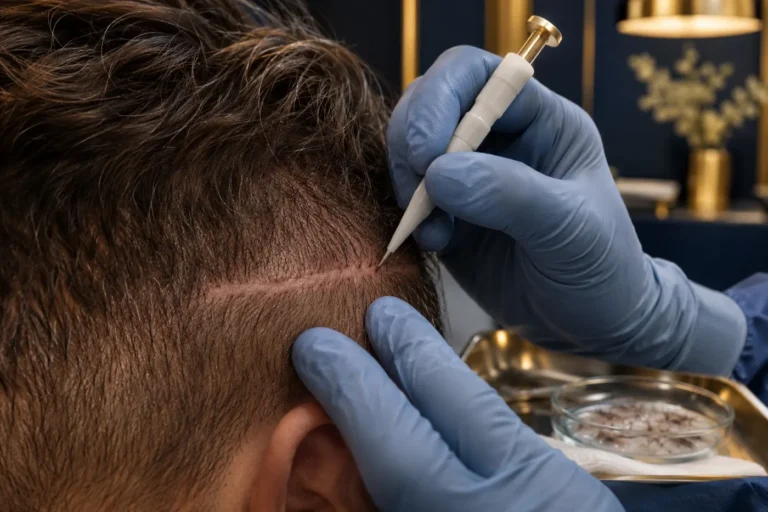
- 2. Extraction: healthy follicles are removed one by one from the back of the head using the FUE technique, under local anaesthesia.
- 3. Implantation: the grafts are placed directly into the scar, usually with a DHI Choi implanter pen. This gives precise control over angle and depth and is gentle on firm scar tissue.
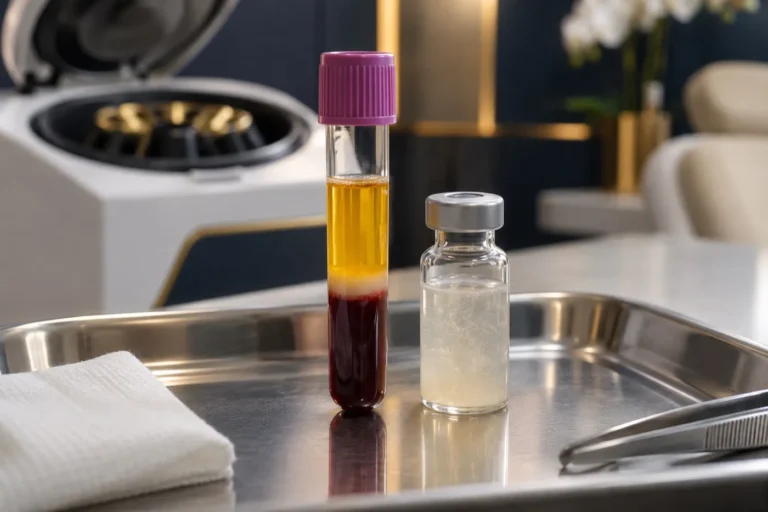
- 4. Healing support: PRP therapy can be added to support blood flow and healing in the treated area.
Because scar tissue has fewer blood vessels, grafts are placed at a slightly lower density than in healthy scalp. This protects the blood supply and gives each graft a better chance to survive. If more density is needed, a second session can be done later.
How many grafts does a scar need?
The number of grafts depends mainly on the scar’s length and width. These are typical ranges:
| Scar type | Typical grafts | Sessions |
|---|---|---|
| Small scar (up to 2-3 cm) | 200-500 | Usually 1 |
| FUT strip scar | 500-1,200 | 1-2 |
| Larger accident or surgical scar | 800-1,500 | 1-2 |
| Eyebrow or beard scar | 100-400 | Usually 1 |
These numbers are only a guide. We give you a personal estimate after reviewing photos of your scar and donor area.
How successful is a hair transplant into scar tissue?
Grafts can survive and grow well in scar tissue, but survival is usually somewhat lower than in normal scalp because the blood supply is weaker. Thin, flat, soft scars respond best. Thick, shiny, very tight or burn scars are more challenging. For these, a small test session of a few hundred grafts can show how the tissue reacts before a larger session.
Good planning makes the biggest difference: realistic density, careful handling of each graft and a surgeon who has worked on scars before.
Recovery and results timeline
- First 7-10 days: small crusts form and fall off. Most people return to office work after 2-3 days.
- Weeks 2-8: transplanted hairs often shed. This is normal; the follicles stay in place.
- Months 3-4: new hairs begin to grow through the scar.
- Months 12-18: the final result is visible. Scar tissue can be a little slower than normal scalp.
Who is not a good candidate?
A scar hair transplant may not be suitable if the scar is still red or changing (less than 6-12 months old), if scarring alopecia is still active, if the scar is very thick with almost no blood supply, or if the donor area is too weak to give enough grafts. In these cases we explain the options honestly, including waiting or treating the scar first.
Frequently asked questions
Can hair really grow on scar tissue?
Yes. Scar tissue has no hair follicles of its own, but healthy follicles taken from your donor area can survive and grow in it. Because scar tissue usually has a weaker blood supply than normal scalp, the survival rate can be somewhat lower, so we plant at a careful density and support healing with PRP.
How long after an injury or surgery can I have a scar hair transplant?
The scar should be fully mature and stable. In most cases that means waiting at least 6 to 12 months after the injury, accident or operation, until the scar is no longer red, swollen or changing.
How many grafts does a scar need?
It depends on the length, width and location of the scar. Small scars often need 200 to 500 grafts, while long FUT strip scars or larger accident scars can need 800 to 1,500 grafts. We give you an exact estimate after reviewing photos of your scar.
Will I need more than one session?
Small and medium scars are often covered in one session. Wide, thick or very tight scars, and burn scars, may need a second session about 8 to 12 months later to reach full density.
Can a FUT (strip) scar from a previous hair transplant be covered?
Yes, this is one of the most common reasons patients come to us. Grafts are implanted directly into the linear scar so it blends with the surrounding hair, even when you wear your hair shorter.
Can burn scars and scarring alopecia be treated?
Sometimes. Burn scars and scarring alopecia (cicatricial alopecia) need a careful assessment of skin thickness and blood supply. Scarring alopecia must be inactive, usually for at least one to two years, and confirmed by your dermatologist before any transplant. In some cases we recommend a small test session first.
Is a scar hair transplant painful?
The procedure is done under local anaesthesia, so you should feel no pain during treatment. Mild tightness or tenderness for a few days afterwards is normal and is managed with simple painkillers.
When will I see the results?
Transplanted hairs usually shed in the first weeks, then new growth starts around month 3 to 4. Scar tissue can be a little slower than normal scalp, and the final result is typically visible at 12 to 18 months.
Get a free scar analysis
Every scar is different. Send clear photos of your scar and the back of your head through our free online hair analysis or on WhatsApp. Our team in Tirana will tell you whether you are a candidate, how many grafts you need and what result you can realistically expect.


 English
 Italian
 Albanian