
Scar Hair Transplant
Hair can grow on scar tissue. We move your own healthy follicles into old strip scars, accident and surgical scars and stable scarring patches, so the scar disappears into natural-looking hair.
Procedure Details
Scar hair transplant at a glance
- What it is: your own hair follicles are moved from the back of the head into the scar, where they keep growing for life.
- Who it helps: FUT strip scars, FUE dot scars, accident and injury scars, surgical scars, selected burn scars, eyebrow and beard scars.
- When: once the scar is mature, usually at least 6-12 months after the injury or operation.
- How many grafts: most scars need about 200-1,500 grafts, depending on size and location.
- Sessions: one session is often enough; wide or tight scars may need a second session after 8-12 months.
- Results: new growth from month 3-4, final result at 12-18 months.
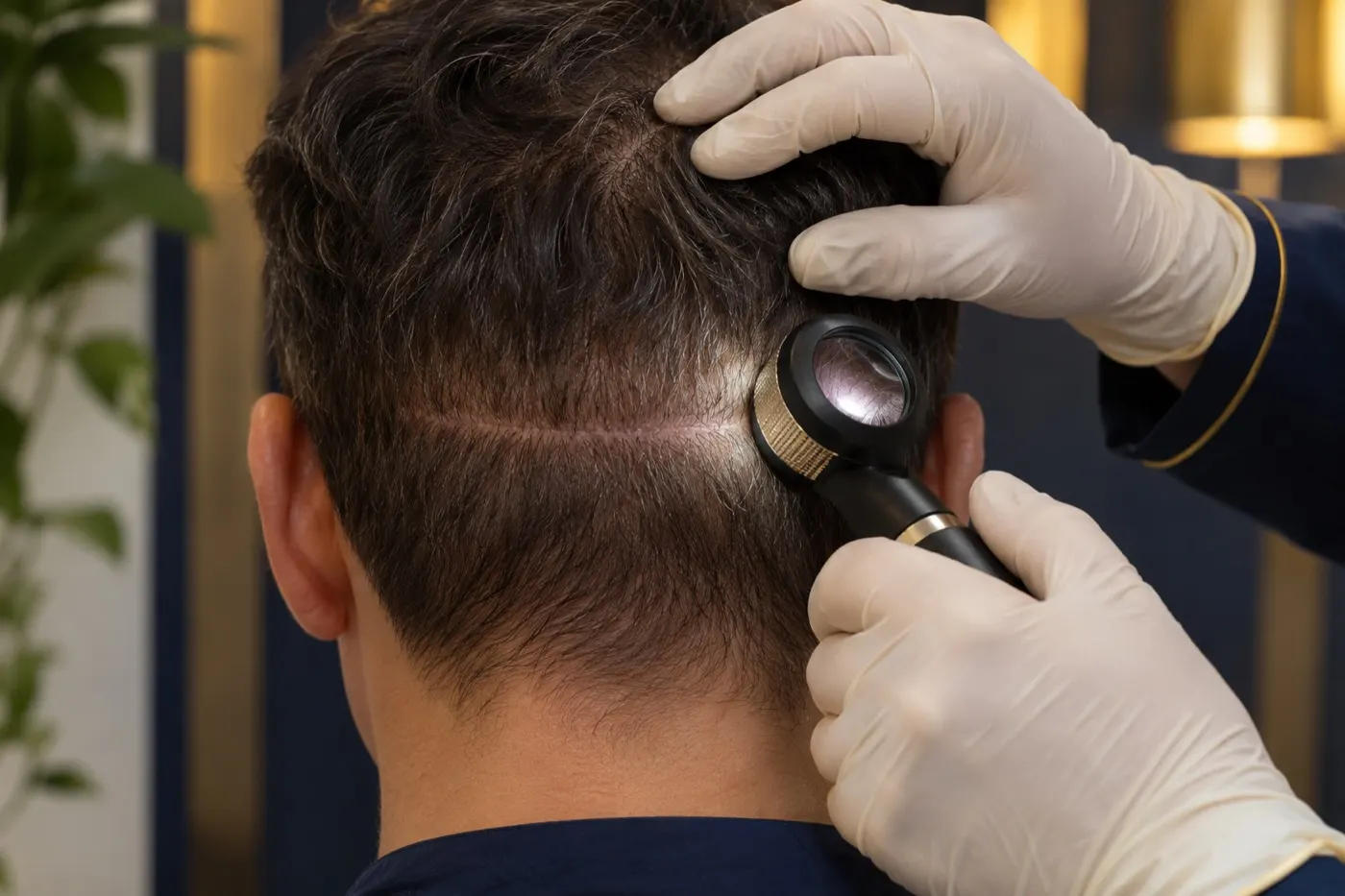
Hair Transplant into Scar Tissue
A scar has no hair follicles, so hair cannot grow back on it by itself. In a scar hair transplant, individual follicles are taken from the donor area with the FUE method and implanted directly into the scar. Once they settle, they grow like the rest of your hair and the scar becomes hard to see.
Scar tissue is firmer and has a weaker blood supply than normal scalp. That is why the planning is different: we place grafts at a careful density, use a fine DHI Choi implanter pen to protect the tissue and can add PRP therapy to support healing.
Every scar is assessed individually by our medical team, led by Dr. Gönül Kiracı. We check the size, thickness, elasticity and colour of the scar and the strength of your donor area before we tell you whether you are a candidate. Scars in the eyebrows can also be treated with our eyebrow transplant technique.
Scars We Can Treat
FUT Strip Scars
The linear scar left by an older strip (FUT) hair transplant at the back of the head, so you can wear your hair shorter again.
FUE Dot Scars
Small white dots in an over-harvested donor area, filled with single grafts to even out the look.
Accident & Injury Scars
Scars on the scalp from falls, accidents, sports injuries or cuts that left a visible bald line or patch.
Surgical Scars
Scars after neurosurgery, face-lift or other operations on the head, once the area has fully healed.
Selected Burn Scars
Burn scars with enough thickness and blood supply. A small test session may be advised first.
Eyebrow & Beard Scars
Gaps in the eyebrows, beard or moustache caused by scars, rebuilt with single-hair grafts at the right angle.
Scar Hair Transplant Process
Photo Analysis
Send clear photos of your scar and donor area. We tell you if you are a candidate and estimate the grafts.
Scar Assessment
In the clinic, the doctor checks scar thickness, elasticity and blood supply and plans the density.
FUE Extraction
Healthy follicles are taken one by one from the donor area under local anaesthesia.
DHI Implantation
Grafts are implanted into the scar with a Choi pen at natural angles. PRP can support healing.
Scar Hair Transplant Questions
Can hair really grow on scar tissue?
Yes. Scar tissue has no hair follicles of its own, but healthy follicles taken from your donor area can survive and grow in it. Because scar tissue usually has a weaker blood supply than normal scalp, the survival rate can be somewhat lower, so we plant at a careful density and support healing with PRP.
How long after an injury or surgery can I have a scar hair transplant?
The scar should be fully mature and stable. In most cases that means waiting at least 6 to 12 months after the injury, accident or operation, until the scar is no longer red, swollen or changing.
How many grafts does a scar need?
It depends on the length, width and location of the scar. Small scars often need 200 to 500 grafts, while long FUT strip scars or larger accident scars can need 800 to 1,500 grafts. We give you an exact estimate after reviewing photos of your scar.
Will I need more than one session?
Small and medium scars are often covered in one session. Wide, thick or very tight scars, and burn scars, may need a second session about 8 to 12 months later to reach full density.
Can a FUT (strip) scar from a previous hair transplant be covered?
Yes, this is one of the most common reasons patients come to us. Grafts are implanted directly into the linear scar so it blends with the surrounding hair, even when you wear your hair shorter.
Can burn scars and scarring alopecia be treated?
Sometimes. Burn scars and scarring alopecia (cicatricial alopecia) need a careful assessment of skin thickness and blood supply. Scarring alopecia must be inactive, usually for at least one to two years, and confirmed by your dermatologist before any transplant. In some cases we recommend a small test session first.
Is a scar hair transplant painful?
The procedure is done under local anaesthesia, so you should feel no pain during treatment. Mild tightness or tenderness for a few days afterwards is normal and is managed with simple painkillers.
When will I see the results?
Transplanted hairs usually shed in the first weeks, then new growth starts around month 3 to 4. Scar tissue can be a little slower than normal scalp, and the final result is typically visible at 12 to 18 months.
Ready to Hide Your Scar?
Send us clear photos of your scar on WhatsApp. Our team will tell you whether you are a candidate and how many grafts you need, free and without obligation.
 English
 Italian
 Albanian